SpyCatcher–modified sensor chips
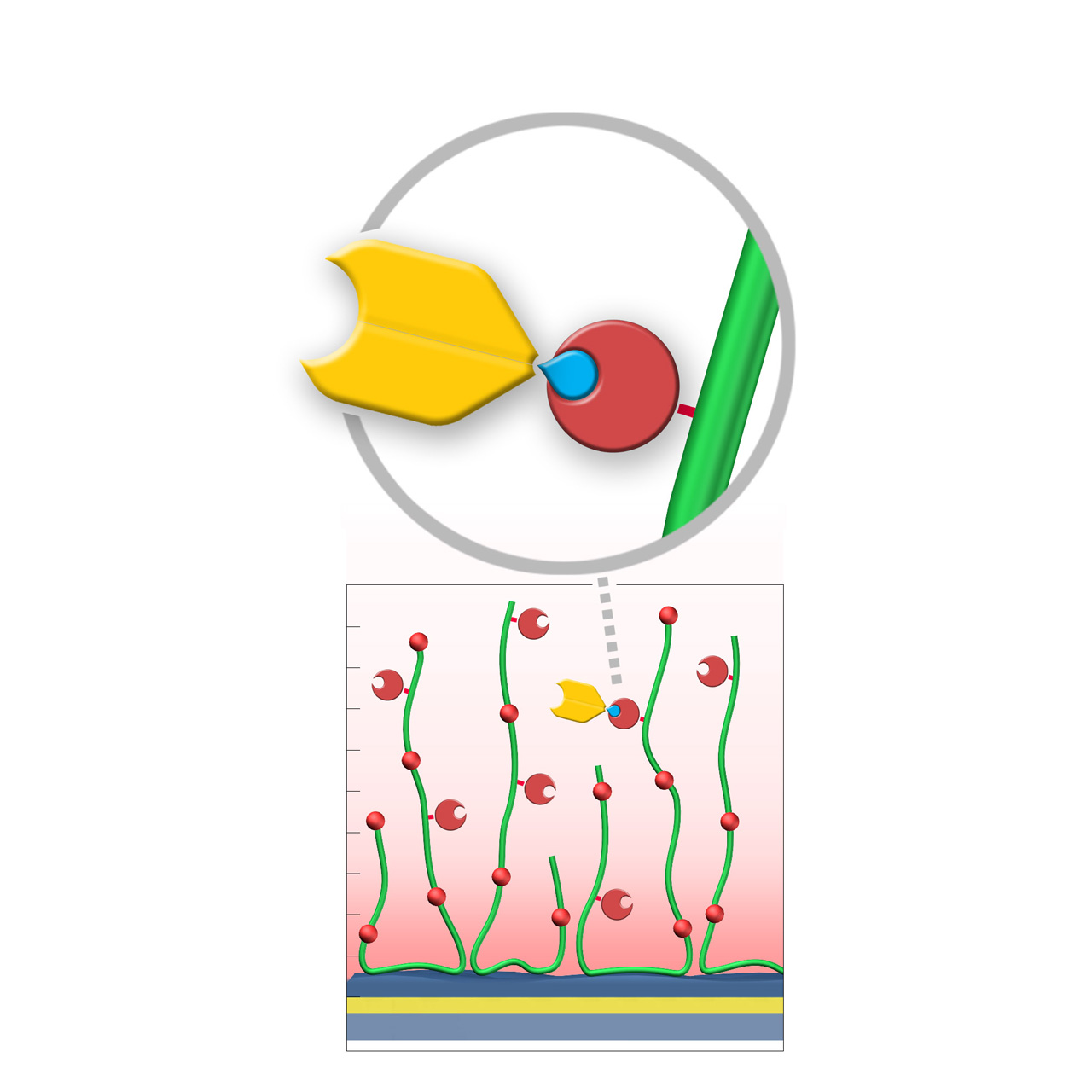
XanTec’s SPY sensor chips are coated with a bioinert (poly)carboxylate matrix pre-functionalized with recombinant 12.8 kDa SpyCatcher3™ protein1. Immobilized SpyCatcher3 rapidly forms highly stable covalent isopeptide bonds with Spy-tagged proteins under physiological conditions, specifically within pH 5–8 and 4–37 °C.
While site-directed and stable ligand immobilization under physiological conditions can also be achieved with the widely used streptavidin/biotin system (e.g., AviTag™), the SpyCatcher/SpyTag system offers two key advantages. First, the interaction is truly covalent, yielding exceptional long-term stability and drift-free binding, which enhances the reliability of kinetic and equilibrium measurements. Second, SpyCatcher3 is considerably smaller than streptavidin, occupying less volume within the hydrogel matrix and enabling higher ligand capture densities.
Combining these benefits, SPYD200M and SPYHC200M sensor chips—with their high immobilization capacities—are particularly well suited for interaction studies involving short peptides, small molecules, and fragments. In contrast, SPYP sensor chips provide a unique combination of lower immobilization capacity and excellent diffusion characteristics typical of 2D coatings, making them ideal for protein-protein interaction studies, especially systems with fast on- and off-rates (e.g., weak binders).
XanTec’s SpyCatcher3-modified surfaces are fully compatible with SpyTag generations 1–3, ensuring broad applicability across diverse experimental needs.
Key features:
- Fast assay development: No preconcentration or chemical activation required. Ligand immobilization occurs directly under physiological conditions with adjustable ligand density, enabling rapid and reproducible assay setup.
- Exceptional stability: Covalent SpyCatcher/SpyTag coupling results in drift-free, permanently immobilized ligands.
- Oriented immobilization: Site-directed attachment via N- or C-terminal SpyTag ensures maximum ligand activity.
- Versatile capture capacity: Available on CMDP, CMD, and HC base coatings, offering different immobilization densities for specific experimental requirements.
| Product code | SPYP | SPYD200M | SPYHC200M |
|---|---|---|---|
| Base coating | 2D, ultra-short CM-Dextran (high density) |
3D, 200 nm bioinert CM-dextran (medium density) |
3D, 200 nm bioinert polycarboxylate (medium density) |
| Capture immobilization capacity [µRIU]3 | ≈ 100 | ≈ 500 | ≈ 500 |
| Recommended ligands | Spy-tagged peptides and proteins | Spy-tagged peptides and proteins | Spy-tagged peptides and proteins |
| Recommended analytes |
|
|
|
| Intended purpose |
|
|
|
1 SpyCatcher3 carries a His-tag that may interact with certain ligands or analytes.
2 All illustrations are schematic representations and are not drawn to scale; dimensions, densities, and spatial relationships do not reflect actual physical or chemical proportions.
3 Based on the specific capture immobilization of 100 nM Spy-Tag, with 1 µRIU corresponding approximately to 1 RU.