RG sensor chips
XanTec’s RGD200M sensor chips are coated with a bioinert carboxymethyl-dextran matrix derivatized with a 24-nt single-stranded DNA oligo sequence. This oligo is capable of binding ligands conjugated to the complementary DNA sequence via hybridization of the two DNA strands. While the captured ligand is bound stably under physiological conditions, complete regeneration of the chip can be achieved by denaturation of the double-stranded DNA at alkaline pH, liberating the surface-bound oligo for another capture cycle.
XanTec offers two variants for DNA-mediated, reversible ligand immobilization using the RGD200M sensor chip.
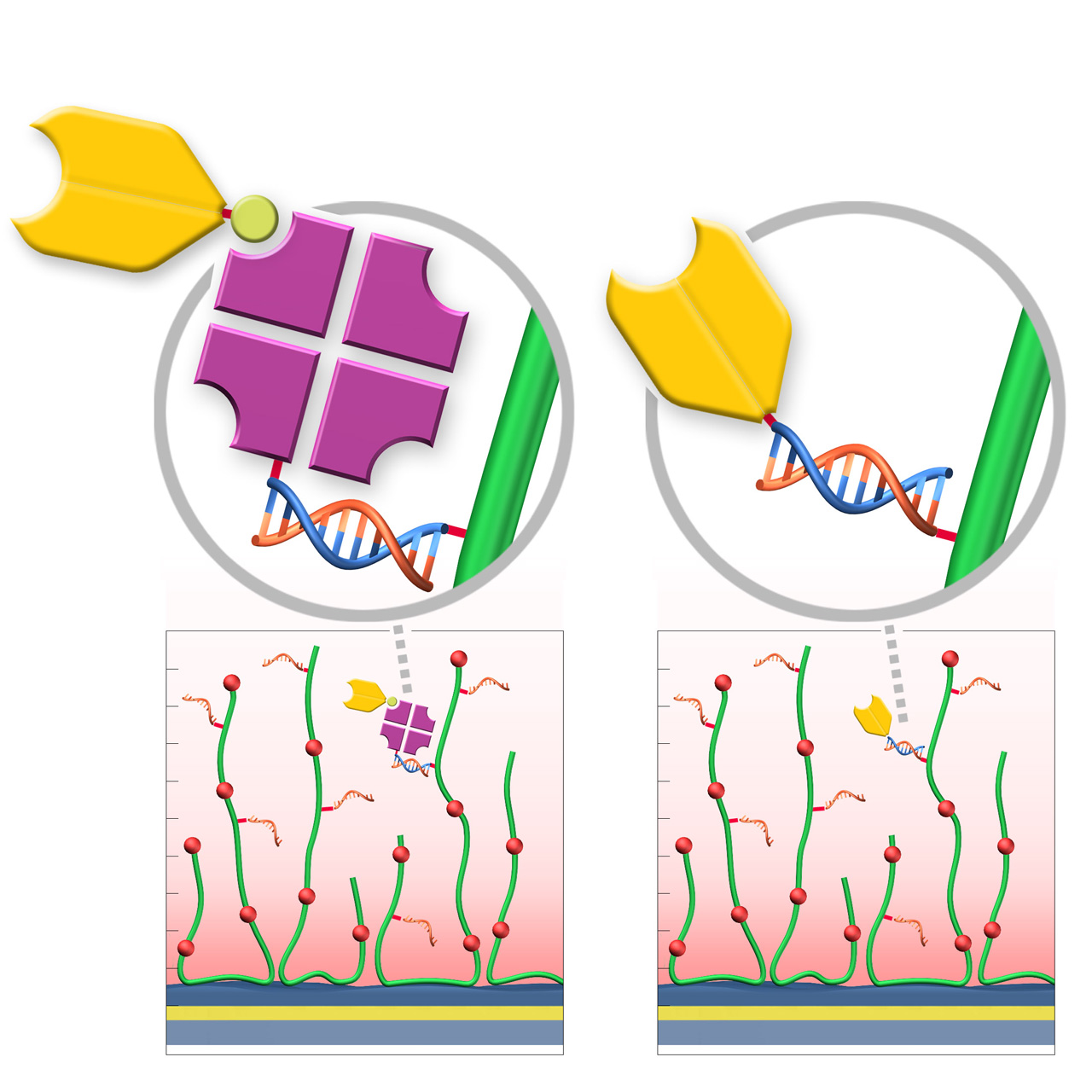
Variant 1: The RG biotin capture reagent RG-SA (streptavidin pre-conjugated with the complementary DNA oligo) is immobilized on the RGD200M sensor chip via DNA hybridization. A biotinylated ligand is then injected, binding streptavidin with high affinity and stability. Immobilization levels are controlled by ligand concentration and injection duration.
Variant 2: The ligand is functionalized with dibenzocyclooctyne (DBCO) using the XanTec DBCO Labeling Kit, desalted, and subsequently reacted with the RG-modifier DNA oligo via a selective Click reaction. The resulting DNA–ligand conjugate is directly immobilized on the RGD200M sensor chip through DNA hybridization, thereby eliminating the intermediate streptavidin capture step. Immobilization levels are controlled by ligand concentration and injection duration.
This approach can reduce nonspecific binding, lower diffusion limitations, enable higher capture densities, and facilitate surface regeneration, ultimately improving data quality while reducing assay setup time.
Key features:
- Very fast assay development: No preconcentration, no surface activation, and no screening for regeneration conditions required. Controlled ligand immobilization is performed under physiological conditions, reducing preparation time and ensuring reproducibility.
- Maximum flexibility: Regenerable alternative to classic streptavidin/biotin capture immobilization.
- Exceptional stability: Drift-free immobilization of oligo-modified streptavidin.
- Simple regeneration: Quantitative, rapid regeneration allows > 100 capture/regeneration cycles.
- Oriented immobilization: Controlled biotinylation via biomolecular tools such as AviTag allows for maximum ligand activity and reproducible immobilization results.
- Ideal for large screening campaigns: Particularly well suited for studies requiring repeated immobilization of the same ligand across many cycles or sensor chips.
| Product code | RGD200M | |
|---|---|---|
| Base coating | 3D, 200 nm bioinert CM-dextran (medium density) | |
| Variant | Variant 1: RG-SA | Variant 2: RG-Modifier |
| Capture immobilization capacity [µRIU] | ≈ 3,5002 | ≈ 5,0003 |
| Recommended ligands | biotinylated proteins or peptides | proteins or peptides possessing an NHS-reactive amino group |
| Recommended analytes |
|
|
| Intended purpose |
|
|
1 All illustrations are schematic representations and are not drawn to scale; dimensions, densities, and spatial relationships do not reflect actual physical or chemical proportions.
2 Based on the specific capture immobilization of 100 µg/mL biotinylated BSA in PBS (RG-SA pre-capture), with 1 µRIU corresponding approximately to 1 RU.
3 Based on the specific capture immobilization of 200 nM RG-SA on a RGD200M sensor chip.