Protein A–modified sensor chips
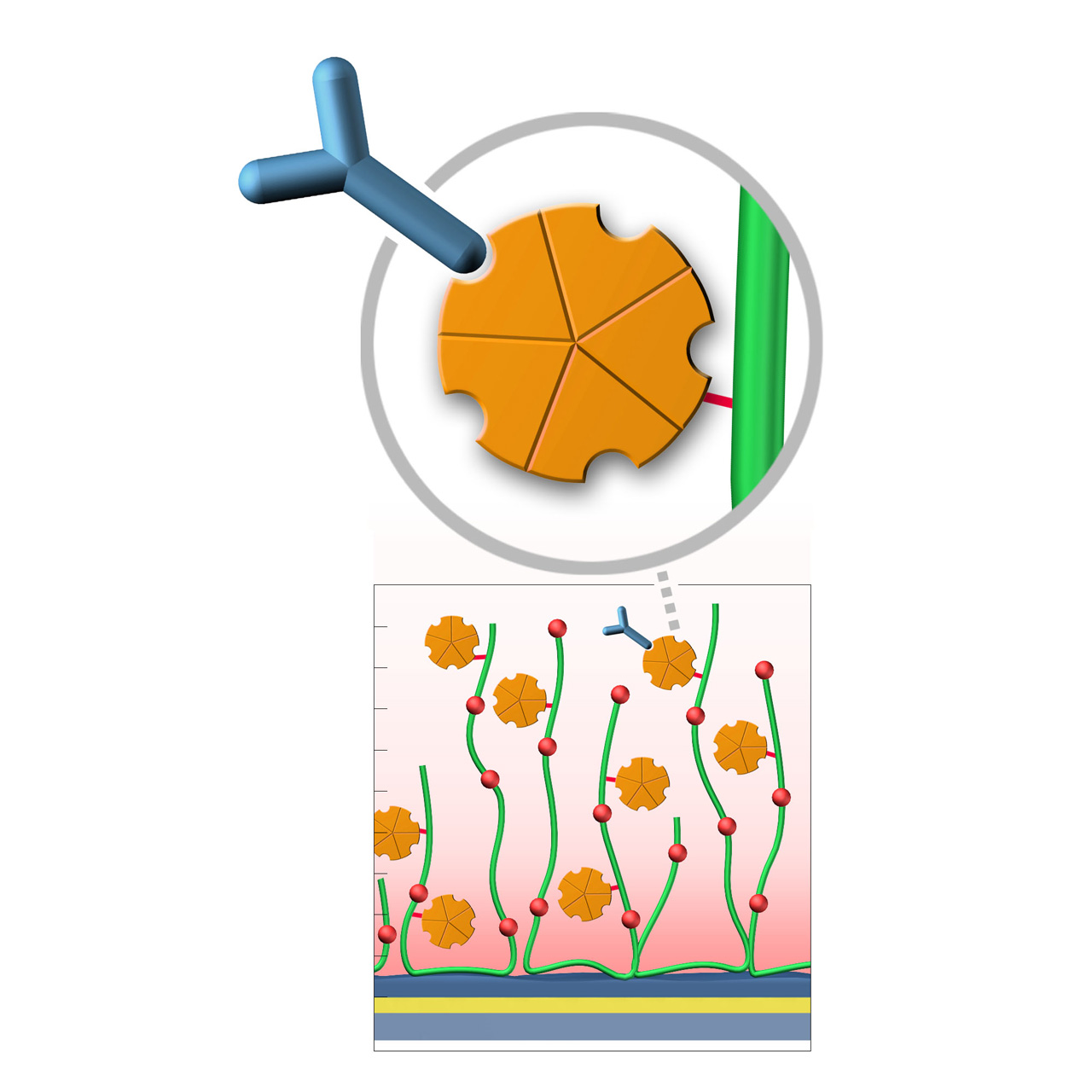
XanTec’s PAP, PAD, and PAHC sensor chips are coated with a bioinert polycarboxylate matrix, pre-functionalized with recombinant 47 kDa Protein A. This non-glycosylated Protein A variant includes five IgG-binding domains providing high-affinity binding to the Fc region of all human IgG1, IgG2, IgG4 subclasses. Additionally, it exhibits strong affinity for mouse IgG2a, IgG2b, and IgG3, as well as total IgG from cow, goat, sheep, rabbit, and other mammals. Due to the slightly hydrophobic character of the Protein A, some nonspecific binding may occur; inclusion of blocking agents (e.g., BSA) and/or nonionic detergents (e.g., Tween) in the running buffer is therefore recommended to minimize background signals.
XanTec’s Protein A sensor chips are ready-to-use, eliminating the need for time-intensive assay optimization and streamlining workflows. With five distinct Protein A-modified versions available for SPR applications, each is tailored to specific analytical needs:
Key features:
- Fast assay development: No preconcentration or surface activation required. Controlled and reversible ligand immobilization is performed under physiological conditions, reducing preparation time and ensuring reproducibility.
- Simple regeneration: Chip surfaces regenerated using glycine·HCl pH 1.5–2.5.
- High stability: XanTec’s Protein A sensor chips help minimize assay costs and maximize reusability.
- Oriented immobilization: High ligand activity is maintained via directed immobilization through the Fc region.
| Product code2 | PAP | PAD200L | PAHC30M | PAHC200M |
|---|---|---|---|---|
| Base coating | 2D, ultra-short bioinert CM-dextran (high density) | 3D, 200 nm bioinert CM-dextran (low density) |
3D, 30 nm bioinert polycarboxylate (medium density) |
3D, 200 nm bioinert polycarboxylate (medium density) |
| Capture immobilization capacity [µRIU]3 | ≈ 5,000 | ≈ 12,000 | ≈ 6,000 | ≈ 11,000 |
| Ligands | Fc region of human IgG1, IgG2, and IgG4 subclasses, strong affinity for mouse IgG2a, IgG2b, and IgG3, and total IgG from cow, goat, sheep, and rabbit | |||
| Analytes |
|
|
|
|
| Intended purpose |
|
|
|
|
1 All illustrations are schematic representations and are not drawn to scale; dimensions, densities, and spatial relationships do not reflect actual physical or chemical proportions.
2 Table includes a selection from XanTec’s full PA sensor chip portfolio.
3 Maximum immobilization capacities are determined based on the capture level from a 100 µg/mL solution of Protein A-purified, pooled rabbit IgG in PBS buffer, with 1 µRIU corresponding approximately to 1 RU.