Dextran–modified sensor chips
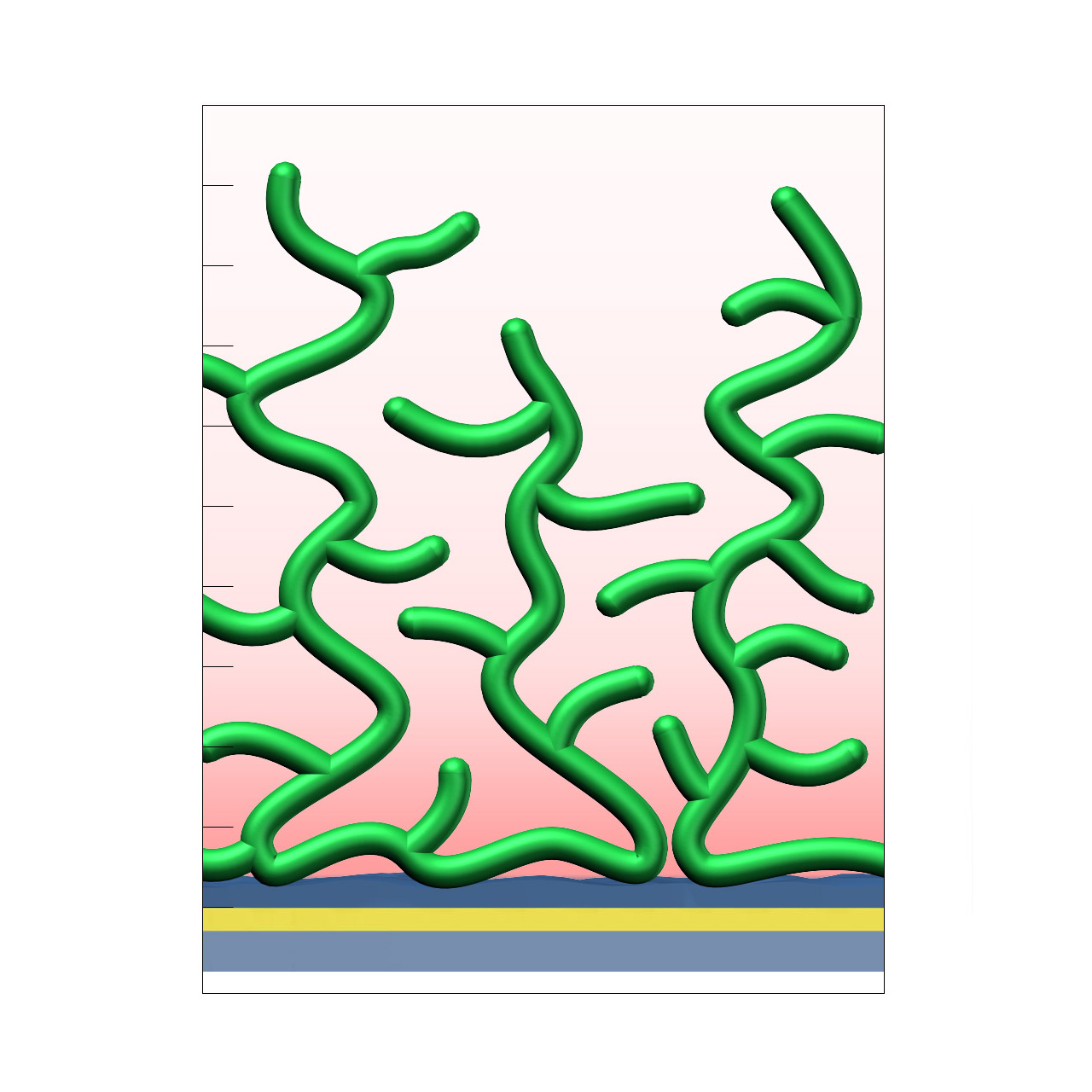
XanTec’s Dextran (D) sensor chips are available as a 2D dextran coating (DP) or as a 3D hydrogel matrix (D200M) composed of unmodified dextran chains grafted onto a hydrophilic adhesion promoter on a gold support. In contrast to carboxymethyl-dextran (CMD) coatings, D-type surfaces carry no charge and therefore do not exhibit electrostatic interactions and do not support electrostatic preconcentration.
Because the surface lacks carboxyl groups, standard EDC/NHS amine coupling is not applicable. Covalent immobilization must rely on alternative chemistries, such as oxidation of dextran to polyaldehydes followed by Schiff base formation / reductive amination, or (bis)epoxy activation. As no electrostatic enrichment occurs, higher ligand concentrations are often required. For these reasons, Dextran sensor chips are not typically the first choice for routine SPR-based kinetic or affinity measurements.
Nevertheless, the absence of charged functional groups provides the surface with exceptionally low nonspecific binding, making D sensor chips a versatile basis for individual immobilization chemistries. Furthermore, D sensor chips can be used as bioinert, low drifting reference coatings for instrument hardware tests, to evaluate nonspecific interactions or to assessnew biomedical and antifouling surface chemistries.
Key features:
- Exceptionally bioinert: The charge-free dextran matrix exhibits extremely low nonspecific binding.
- Protocol compatibility: The polysaccharide matrix is similar to common bioseparation media (e.g., Sephadex), enabling transfer of immobilization protocols developed for crosslinked polysaccharide beads.
| Product code | DP | D200M |
|---|---|---|
| Base coating | 2D, ultra-short bioinert dextran (high density) |
3D, 200 nm bioinert dextran (medium density) |
| Immobilization capacity [µRIU] | Not available | Not available |
| Recommended ligands | Not available | Not available |
| Recommended analytes | Not available | Not available |
| Intended purpose |
|
|
1 All illustrations are schematic representations and are not drawn to scale; dimensions, densities, and spatial relationships do not reflect actual physical or chemical proportions.